From Development to Membership: Rugby Africa’s Impact Across the Continent
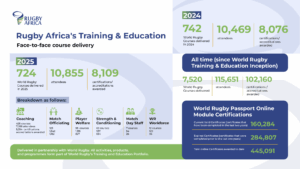
In 2025, Rugby Africa facilitated the delivery of 724 World Rugby Training and Education courses across Africa, with over 10,000 personnel attending across the different categories.
CAPE TOWN, South Africa – In 2025, as delivery partners of World Rugby’s Training and Education Portfolio, Rugby Africa, facilitated the delivery over 8,000 World Rugby accreditations through a series of Training and Education programs across the continent.
Thousands of personnel across all areas of the game have participated in these programs since World Rugby’s Training and Education Portfolio was launched, with over 100,000 accreditations awarded to date.
Participants are trained in key areas of the game such as Coaching, Match Officiating, Player Welfare, Strength and Conditioning and Match-Day Staff. Training of World Rugby’s Licensed delivery workforce is also delivered as part of the programme.
In 2025, Rugby Africa facilitated the delivery of 724 World Rugby courses across Africa, with over 10,000 personnel attending across the different categories.
Rugby Africa’s Regional Training Manager for English-speaking nations, Denver Wannies, says the progress in Africa is being noticed globally, noting that “other regions in the rugby world admire us for what we’ve been able to do”.
World Rugby courses are conducted in the different member Unions by trained and Licenced World Rugby Educators and Trainers, who deliver on behalf of and on approval of their Union, Rugby Africa and World Rugby.
Facilitating the delivery of hundreds of courses in different categories, across the continent and throughout the year, requires outstanding organisational skills. To streamline delivery, the Regional Training Managers adopt the “Super Week” approach.
“Instead of doing individual programmes, we’ve designed what we call a Super Week, where our teams are in a country for about five days,” explains Wannies.
“The (host national) unions are advised to mobilise beforehand. In those five days, we combine different courses from Level One coaching, refereeing, immediate medical care and others. During that Super Week, we also keep the local Licenced World Rugby Educators abreast of any new trends, in what we call Quality Assurance (QA).”
Wannies notes that some of the strongest progress has come from emerging rugby nations such as Nigeria, Ghana and Botswana.
On the medical front, World Rugby’s Medical Education Manager, Dr Joseph Kalanzi, highlights significant advances in this critical area of the sport.
“The majority of the unions are self-sustaining in delivering Level One First Aid in Rugby courses,” says Dr Kalanzi. “It means that the majority of unions have local Licensed World Rugby Educators able to conduct training within their own Union.”
Further work is ongoing to train member Union Doctors and Healthcare Professionals to Level 2 Immediate Care in Rugby standard. Many member Unions are now self-sustaining in the delivery at this level also. Unions participating in Rugby Africa competitions have to meet medical compliance standards to these levels.
World Rugby provides member Unions with Medical Education equipment to support the delivery of the Level 1 First Aid and Level 2 Immediate Care in Rugby courses.
Targets for Medical Education on the continent have been spread across all levels of the game, from the bottom to the top, with higher standards set and met for major tournaments played during the year.
All this has been achieved through the Licenced World Rugby Training and Education delivery Workforce, which consists of: Course Directors, Medical Trainers, Medical Educators and First Aid in Rugby Educators.
“The big unions have all personnel trained at the four levels,” says Dr Kalanzi, adding that concerted efforts continue to be applied to bring the rest of the continent on par with the leading nations.
Tunisia and Madagascar have led course delivery and graduate numbers in Francophone Unions, while Tunisia, Senegal and Côte d’Ivoire are now fully self-sufficient.
“In the English-speaking unions, the big countries do well,” Kalanzi adds. “Kenya, Zimbabwe and Uganda deliver a number of Level 1 First Aid in Rugby and Level 2 Immediate Care in Rugby courses. Honourable mention must also go to Mauritius and Zambia for Level 1 First Aid in Rugby delivery. As for Level 3 Advanced Immediate Care in Rugby, it is only delivered in South Africa due to their participation in the United Rugby Championship.
Charles Yapo, Rugby Africa’s Regional Training Manager for French-speaking nations, has been working with the organisation since 2015. “My satisfaction comes from contributing to rugby development in Africa. Seeing a federation become a full World Rugby member after seven years is priceless.”
Yapo explains his work in the region and how he deals with the different member unions. “As you know, World Rugby has categorised its member federations for better monitoring for the past three years,” he says. “I mainly work with the following federations – Development category: Madagascar and Tunisia. Growth category: Senegal and Côte d’Ivoire. Membership category: Burkina Faso, Cameroon, Morocco, Algeria, Burundi and Egypt. These are 10 federations.”
Momentum remains strong across the continent. “Each year, the numbers are increasing, and thousands of technical staff benefit from World Rugby Training and Education through our network of Licenced World Rugby Educators and Trainers in various fields. These include medical, match officials, coaches, player safety, physical trainers, game protection, match-day staff and federation management. Last year, we exceeded our targets due to the enthusiasm for training. Some federations would like us to visit them two or three times, but our budget is limited,” adds Yapo.
All activities, products and programs form part of World Rugby’s Training and Education Portfolio which they provide as a member service to Unions through partnership with the Regional Associations
Access Release and Media: Click Here
Written by Enock Muchinjo