This page is also available in:
 Français (French)
A Symbol Of Inclusion, Equality And Hope: Senegal Eyes Lasting Rugby Legacy From Youth Olympics
As Dakar prepares to host the 2026 Youth Olympic Games, Senegal sees an opportunity to grow the game, inspire young players and build a more inclusive future for rugby.
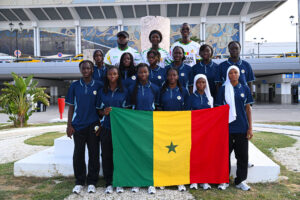
DAKAR, Senegal – From 22 October to 9 November this year, Africa will record yet another sporting milestone when the Senegalese capital, Dakar, hosts the 2026 Youth Olympic Games, the first International Olympic Committee (IOC) event to be staged on the continent.
It will also be the first showcase to be staged under current IOC President Kirsty Coventry, who in March 2025 became the first African head of the prestigious body.
Sevens rugby makes a return to the Youth Olympics for the third time after debuting at the 2014 edition in China before coming back for a second time in 2018 in Argentina.
For 2026 hosts Senegal, what a wonderful opportunity it is for the West African nation to shine in front of a passionate home crowd and further popularise rugby in a country where the sport already enjoys quite a significant following.
Senegal will be represented by both its women’s and men’s teams in Sevens rugby. Fellow African nations South Africa and Uganda will field men’s sides, with Kenya and Madagascar competing in the women’s section.
Fédération Sénégalaise de Rugby Communications Officer Madiagne Niang says being represented in both categories is testament to increased inclusivity in the game in his homeland.
“It is an immense source of pride for Senegal,” Niang tells Rugby Africa Media.
“Having our men’s and women’s teams involved in an event as important as the Youth Olympic Games Dakar 2026 is an exceptional opportunity to showcase the potential of our youth and the progress of our rugby. Beyond the competition, it is also a symbol of inclusion, equality and hope. We want to show that Senegal has its place on the international stage and that our young people, girls and boys alike, can have big ambitions through sport. We also have the responsibility to make this participation a true legacy for future generations, by giving these young people the means to continue their development well beyond the Games.”
While the two Senegalese teams will bring their best onto the playing field, the importance of staging such a big global event and using it to change rugby and communities in the country isn’t lost on the host nation.
“Our ambition goes beyond just sporting results,” Niang comments.
“Of course, we want our two teams to be competitive, to defend Senegal’s colours with dignity and to give their best against the best nations. But our major objective is to build for the future. Never, to our knowledge, has a generation of young Senegalese rugby players, men and women, benefited from such exposure to high-level rugby. We are convinced that this experience will help build one of the most promising generations of Senegalese Sevens rugby for the next 10 years. We want to create a genuine talent pool, capable of enabling Senegal to sustainably aim for the African podium and, eventually, to strengthen its presence on the international scene.
“To achieve this, we will need to build on what has been gained from this preparation: keeping the infrastructure available, continuing the technical support for these youngsters and offering them regular competitions. The Games must not be an end in themselves, but the starting point of a sustainable project.
“Finally, we want Dakar 2026 to leave a human and structural legacy: better-trained coaches, a stronger federation, more opportunities for girls to play rugby and the development of the discipline beyond Dakar and Diamniadio. This is how we will transform this Olympic opportunity into concrete progress for Senegalese rugby.”
Sevens rugby is a spectacle, lots of fun. It is a crowd-puller at events such as the Olympics. The Senegalese will definitely love playing in one of the Games’ most followed codes, with local fans behind them all the way.
“Playing at home, in front of our own people, is a source of motivation, but also a great responsibility,” Niang says.
“For our young players, it’s an opportunity to represent their country in front of their families, their loved ones and a whole nation supporting them. The Senegalese public is known for its passion and hospitality. We hope that this energy will carry our teams and give them the strength to push themselves, even in difficult moments. But beyond sporting support, we want these Games to create a real connection between the population and rugby. We want young Senegalese who discover our teams to be able to identify with these players, to tell themselves that they too can play this sport and, perhaps, one day represent their country. For us, succeeding at home therefore also means inspiring new vocations, strengthening national pride and making rugby an even more accessible and popular sport in Senegal.”
The shorter version of the game is also a convenient format to get more people involved, and the Senegalese have been taking advantage of that.
“Sevens rugby represents a fantastic opportunity for the development of our discipline in Senegal,” Niang says.
“It is a dynamic, spectacular and demanding format, which showcases speed, technical qualities, game intelligence and team spirit. It can also help attract new participants, particularly in schools and among young people. The preparation for the Youth Olympic Games Dakar 2026 is an important accelerator. It allows us to strengthen the training of our players, improve the skills of our coaching staff and expose our young people to the demands of high-level competition. However, the real challenge will be to maintain this momentum after the Games. We must maintain the infrastructure, develop youth competitions, further structure women’s rugby and strengthen our presence in the regions, so that participation is not limited to Dakar and Thiès. We also want to build on local initiatives, such as the Maison du Rugby in Yoff, to combine sports practice with educational support and guidance for young people. Our vision is clear: to make the Dakar 2026 Youth Olympic Games a springboard for building a more structured, more inclusive and more competitive Senegalese rugby, capable of sustainably developing the talented players who will carry our colours in the years to come.”
Women’s Teams
- Pool A
- Australia
- Kenya
- China
- Senegal
- Pool B
- United States
- Spain
- Czechia
- Madagascar
Men’s Teams
- Pool A
- South Africa
- Germany
- Canada
- Senegal
- Pool B
- Argentina
- France
- Japan
- Uganda
Written by Enock Muchinjo
