

The U20 Barthes Trophy: Africa’s Pathway to the Next Generation of Rugby Stars Arrives in Uganda
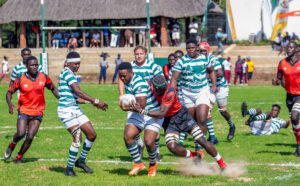
“One of the most important competitions on the African continent”: Zimbabwe Under-20 head coach Shaun De Souza on how the Barthes Trophy is creating pathways for Africa’s future rugby stars.
KAMPALA, Uganda – The Barthes Trophy, Africa’s premier youth rugby competition, is a bridge to success.
It is where the continent’s finest young players are paraded before the world.
Named after the late World Rugby Services Manager for Africa, Jean-Luc Barthes, this Under-20 tournament presents a window of opportunity for everyone involved.
When you speak of the Barthes Trophy and opportunities, you strike a chord with Zimbabwe’s two-time champion head coach, Shaun De Souza, who will be guiding the Junior Sables for the fifth consecutive year at the 2026 edition in Uganda between 7-15 August.
“I’ve been fortunate to have people invest in me throughout my life, and that taught me the importance of giving back,” De Souza tells Rugby Africa Media.
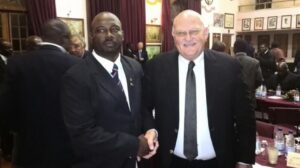
Shaun De Souza (left) with former Prince Edward School headmaster Clive Barnes at the school’s reunion dinner in 2014, where Barnes was the guest of honour.
“Coaching has never been just about rugby for me; it’s about creating opportunities and helping young people become better versions of themselves. Like many people, I’ve experienced challenges growing up, and those experiences taught me gratitude and the value of community. They also showed me that sometimes all a young person needs is someone who believes in them. That has shaped the way I coach. Every player deserves to be seen, challenged and supported, regardless of where they come from.”
Twin brothers Shaun and Shane De Souza were raised in a children’s home in their hometown, Harare. St Joseph’s House for Boys was established in 1929 to take care of orphaned, abandoned, abused and disadvantaged boys.
“We moved from home to home, living with grandma, then grandpa ended up in social welfare care, and we moved to St Joseph’s,” De Souza says.
The twins’ prodigious sporting talents impressed a board member of the home, Clive Barnes, who was the headmaster of Prince Edward School, a prominent public senior school for boys in the Zimbabwean capital city.
Barnes – a respected Zimbabwean educationist, philanthropist and sports enthusiast – enrolled the brothers at Prince Edward and convinced a kindly Harare family, the Kewadas, to sponsor their education.
The two brothers didn’t disappoint, excelling on a variety of sporting fields; Shaun in rugby, basketball and athletics. While Shaun dazzled with his speed and broke several records in sprints, Shane preferred long-distance events as well as hockey, in addition to ballroom dancing.
But it is rugby that flows in the boys’ veins at this school, with a long and proud tradition since its establishment in 1898.
A look at the alumni list of the school shows some recognisable names in world rugby, such as the Zimbabwe-born ex-Springboks Ian Robertson and Tonderai Chavhanga, World Rugby Hall of Fame inductee Kennedy Tsimba, as well as Pieter Benade, the Sables’ current head coach.
Outside the Zimbabwe Under-20 role, De Souza spends time on another passion of his: coaching at his old school. He is the Prince Edward first XV coach, a position he has held for quite some time.
A lot has changed at Prince Edward over the years. For decades, it was an elite public school that operated in many ways at the same level as Zimbabwe’s prestigious private schools.
For a man who wears his roots with pride and carries his upbringing with him, De Souza relates with the present crop of Prince Edward pupils and thrives working in such an environment. Rugby is one area that hasn’t lost its soul at Prince Edward, constantly competing on equal footing with the more affluent schools.
Four players that were in Zimbabwe’s squad for the first phase of the World Rugby Nations Cup in the United States and Canada – Godfrey Muzanargwo, Dylan Utete, Dion Khumalo and Takudzwa Musingwini – came through De Souza’s capable hands at Prince Edward.
In total, seven of the players that toured North America with the Sables are protégés of De Souza.
Khumalo and Musingwini followed from school all the way to the Zimbabwe Under-20s. Then Edward Sigauke, Bryan Chiang and Simbarashe Siraha – who were with the senior Sables in North America as well – have also played Barthes Trophy rugby for Zimbabwe under De Souza over the past four years.
The Junior Sables were in a league of their own in the 2022 and 2023 editions in Kenya, brushing aside everyone on their way to back-to-back titles.
In 2023, the Zimbabwean side was captained by loose-forward Shingi Manyarara, now one of the finest young talents in world rugby, consistently putting in stellar performances for Top 14 club Racing 92 in France.
This is what De Souza and the Barthes Trophy have contributed to Zimbabwe and the world so far, and the 48-year-old Junior Sables gaffer believes other nations can equally use this youth competition to produce quality players who can succeed at the highest level.
“I think it’s one of the most important competitions on the continent,” says De Souza. “It provides young players with genuine international exposures at a critical stage of their development. For African rugby to continue growing, we need strong age-group competitions. The Barthes Trophy creates pathways, develops coaches and officials, and prepares players for professional rugby. The quality has improved significantly over the years, and that’s good for every nation involved. A stronger African benefits everyone.”
After the heights of 2022 and 2023, success has, however, eluded Zimbabwe in the Barthes Trophy in the last two tournaments. Hosting the last two tournaments back-to-back in Harare, the Junior Sables had their dominance ended by Kenya in 2024 and Namibia in 2025, as both nations claimed record three titles each since the tournament was rebranded in 2017.
Returning to East Africa for the 2026 edition, De Souza is looking back at the events of the past four years as motivation in the search for not just a third title of their own, but also for unearthing new gems for his country.
“It’s been an incredible journey,” says De Souza.
“Every campaign has presented different challenges, different squads and different lessons. We’ve celebrated success, experienced disappointment, and continued to grow and learn.
“We’re extremely motivated. Success isn’t something you inherit; it’s something you earn every single day.
“Our focus isn’t on talking about winning the title. Our focus is on preparing exceptionally well, building a connected team and performing to our potential. If we consistently execute our processes, compete for every moment and represent Zimbabwe with pride, then we’ll give ourselves every opportunity to be successful.
“We’re fortunate to have a balanced squad with a good mix of physicality, athleticism and rugby intelligence. What excites me most isn’t necessarily individual stars, but the collective character of the group. We have players who I believe have the potential to become future Sables.
“When I see former Junior Sables wearing the green and white, I get goosebumps. I don’t just see talented rugby players, I see young men who have embraced responsibility, leadership and service to their country. That makes me incredibly proud.”
De Souza, a former Sables speedy winger considered one of Zimbabwe’s best players of his generation, is a devout Muslim who bases his coaching on key life principles. “My Faith is central to who I am,” says De Souza.
“It gives me perspective, humility and purpose. It reminds me that leadership is about serving others and treating people with respect and compassion.
“In rugby, those values translate naturally. Honesty, discipline, accountability, hard work and humility are qualities that every successful team needs. While our squad comes from different backgrounds and beliefs, we create an environment where everyone is respected. Unity doesn’t come from everyone being the same; it comes from everyone working towards the same purpose.”
Performance Division
- Namibia
- Zimbabwe
- Kenya
- Tunisia
First Division
- Madagascar
- Zambia
- Uganda
Where to watch?
Rugby Pass TV: https://rugbypass.tv/home
Rugby Africa Facebook: https://www.facebook.com/RugbyAfrique
Friday 7 August 2026 (EAT)
- 10:00 – Namibia vs Tunisia (Performance Division)
- 13:00 – Kenya vs Zimbabwe (Performance Division)
- 16:00 – Zambia vs Uganda (First Division)
Tuesday 11 August 2026 (EAT)
- 10:00 – Zambia vs Madagascar (First Division)
- 12:00 – LM1 vs LM2 (Performance Division)
- 15:00 – WM1 vs WM2 (Performance Division) (Winner of Tournament)
Saturday 15 August 2026 (EAT)
- 16:00 – Uganda vs Madagascar (First Division)
Written by Enock Muchinjo
